RELATED_LOGS







Pathways to AGI: Compression, Robotics, and the Final Speculation

The Semantic Illusion: Why Language is a Shadow of Intelligence
We are living through the intoxicating dawn of generative artificial intelligence, an era defined by the breathtaking fluency of Large Language Models (LLMs). Systems like GPT-4, Claude, and Gemini possess an uncanny ability to converse, reason, write code, and draft legal briefs. Because humans are fundamentally social, language-driven creatures, our instinct is to anthropomorphize this fluency as true comprehension. We see grammatically perfect sentences and assume there is a ghost in the machine. Yet, from a strictly epistemological standpoint, these models are sophisticated illusionists. They are trapped in what philosophers call the Chinese Room, manipulating symbols with astonishing statistical precision without ever touching the reality those symbols represent.
To understand the true trajectory of Artificial General Intelligence (AGI), we must strip away the magic and look at the underlying mathematics. The current paradigm of AI relies on autoregressive token prediction—guessing the next piece of a sequence based on the vast distribution of human text. But language is deeply flawed as a foundational substrate for true intelligence. Language is merely a low-dimensional, highly compressed projection of a high-dimensional, infinitely complex physical reality. Words are the shadows on the wall of Plato’s Cave. To build an entity capable of general intelligence, we cannot simply train it on more shadows. We must force it to step out of the cave, interact with the objects casting those shadows, and measure the physical consequences of its actions.
This leads us to the two true, inseparable stepping stones to AGI: advanced compression algorithms that mathematically synthesize world models, and embodied AI (robotics) that grounds these models in the unforgiving, error-bounding limits of physical reality. Together, they form a closed-loop system of comprehension and verification that pure text models can never achieve.
Compression is Comprehension: The Mathematical Heart of Intelligence
To understand why a robot is necessary, we must first understand what the “brain” of that robot is actually doing. In information theory and theoretical computer science, there is a concept closely tied to intelligence: data compression. In 2006, computer scientist Marcus Hutter introduced the Hutter Prize, offering a cash reward to anyone who could losslessly compress a specific snapshot of human knowledge (Wikipedia) smaller than the previous record. Hutter’s hypothesis was simple yet profound: true data compression requires intelligence, and ultimate compression requires AGI.
Why is compression equivalent to intelligence? Consider a sequence of numbers: 2, 4, 8, 16, 32, 64, 128. If you want to store this sequence in a computer, you could memorize every single digit. This takes up significant memory. Alternatively, if you understand the underlying rule—$2^n$—you can compress the entire infinite sequence into a tiny mathematical formula. By discovering the causal rule, you have compressed the data. Neural networks are essentially colossal compression algorithms. When an LLM ingests terabytes of human text, it cannot memorize it all. Through the mechanism of gradient descent, it is forced to compress the data by finding the underlying structural patterns, syntactical rules, and semantic relationships.

Ilya Sutskever, one of the foundational architects of modern deep learning, has repeatedly articulated this philosophy. To predict the next token perfectly, a neural network is mathematically forced to learn the underlying world model that caused the text to be generated in the first place. If an AI reads a mystery novel and correctly predicts the name of the killer on the final page, it hasn’t just guessed a word; it has learned to model human motives, physical constraints, timelines, and logic. Compression breeds comprehension.
However, pure language compression suffers from a fatal mathematical bottleneck: it is compressing an already lossy medium. Language leaves out 99% of reality. When you read the word “apple,” you do not experience the crisp resistance of the skin, the granular spray of juice, the gravitational weight of it in your palm, or the subtle acoustic crunch. An LLM learns that the token “apple” is statistically related to “red,” “fruit,” and “crunchy.” It builds a brilliant, multidimensional map of how words relate to other words. But these are floating signifiers. Without a physical ground truth, the ultimate compression algorithm will eventually compress itself into absurdities.
The Drift of the Disembodied: The Autoregressive Hallucination Problem
This brings us to the most persistent and intractable problem in modern AI: hallucination. In the tech industry, hallucination is often treated as a temporary software bug, something that can be ironed out with more Reinforcement Learning from Human Feedback (RLHF) or better prompt engineering. But mathematically, hallucination is not a bug; it is an inherent feature of disembodied, ungrounded autoregressive models.
When an LLM generates text, it samples the next token based on a probability distribution, feeds that token back into its own context window, and predicts the next one. If there is even a minuscule error or semantic deviation in step one, that error is fed back into the system as absolute truth for step two. Over long horizons, these microscopic deviations compound exponentially. The model drifts away from factual reality because it has no mechanism to anchor its logic back to an objective truth. A fascinating exploration of this phenomenon can be found in research exploring the inherent limitations of autoregressive models, proving that without external grounding, error accumulation is mathematically unavoidable.
An intelligence isolated from the physical laws of the universe is a brain in a vat, doomed to eventually dream itself into madness.
Human beings do not suffer from this compounding drift because our internal predictive models are constantly subjected to an unyielding external judge: physics. If you close your eyes and predict that there is a chair in front of you, you can take a step forward. If your prediction is wrong, your shin hits the coffee table. The physical universe provides immediate, high-fidelity, undeniable error signals. Pain, resistance, gravity, and thermodynamics act as the ultimate bounds on human hallucination. When your internal model of reality deviates from actual reality, the physical world snaps you back into alignment.
An LLM has no coffee table to hit. It has no physical feedback loop to bound its errors. It exists in a frictionless, weightless vacuum where any sequence of statistically probable words is equally “true” to the network. This is why pure software AI, no matter how large the parameter count becomes, will asymptote before reaching true AGI. It requires the friction of reality to bound its loss function.
Embodied AI: Reality as the Ultimate Loss Function
The solution to the disembodied mind is, necessarily, a body. Embodied AI—the synthesis of foundational neural architectures with physical robotics—is not merely a side-quest in the pursuit of AGI. It is the core requirement. By instantiating a predictive compression model into a robotic chassis, we force the intelligence to test its world models against the immutable laws of physics.
Historically, robotics has been hampered by Moravec’s Paradox, the observation that high-level reasoning requires very little computation, but low-level sensorimotor skills require enormous computational resources. It is trivial to make an AI pass the bar exam; it is historically nearly impossible to make a robot fluidly fold a laundry shirt or walk through a cluttered, unfamiliar room. This is because the physical world is continuous, chaotic, and endlessly variable, unlike the discrete, clean world of digital text tokens.
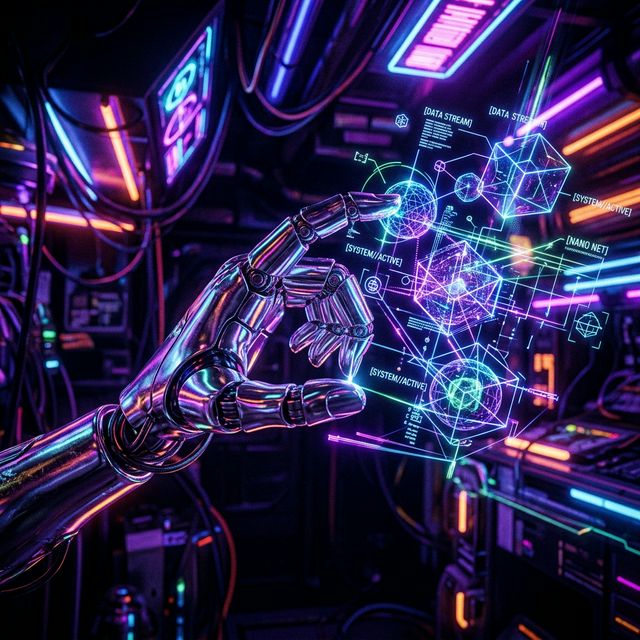
But the paradigm is shifting violently. We are moving away from traditional robotics—which relied on rigid, human-coded kinematics and PID controllers—toward end-to-end neural networks. Companies like Figure, Boston Dynamics, and Tesla are pioneering approaches where robots learn via imitation and reinforcement learning. The robot captures high-bandwidth, multimodal data: stereoscopic vision, tactile pressure sensors, proprioceptive joint torque, and spatial acoustics. It pushes this vast torrent of data through a neural network, which attempts to compress this sensory input into a predictive model of the physical world.
When a robotic hand attempts to grasp a delicate glass and shatters it, the system registers a massive spike in its loss function. The error is not abstract; it is calculated in measured newtons of force, shards of broken material, and the failure to achieve the target state. Physics does not grade on a curve. Gravity cannot be hallucinated away. The physical universe forces the compression algorithm to be absolutely rigorous. If the robot’s internal world model does not perfectly map to the physical world, the robot fails. Therefore, to succeed at general physical tasks, the robot’s neural network must develop an exact, un-hallucinated understanding of mass, friction, inertia, and geometry.
Bounding the Error: How Physics Cures the AI Mind
The mathematical magic happens at the intersection of control theory and deep learning. In a pure text model, the loss function evaluates the difference between the generated word and the target word. In embodied AI, the system relies on predictive architectures, highly reminiscent of the concepts proposed by Yann LeCun in his work on Joint Embedding Predictive Architectures (JEPA). The system observes the current state of the world, plans an action, and predicts what the sensory input of the next state will be.
If a humanoid robot pushes a block of wood across a table, its internal model predicts the visual location of the block, the sound of the sliding wood, and the resistance felt in its arm servos. As the action occurs, the robot compares its prediction to the actual raw sensory data flooding in. The delta between the prediction and the reality is the error. Because physics operates within strict mathematical boundaries (Lipschitz continuity, energy conservation), the error signals are grounded. They do not allow for runaway compounding hallucinations.
This grounds the AI’s understanding of causality. An LLM might say “the glass broke because it fell,” but it relies entirely on linguistic co-occurrence. An embodied AI knows the glass broke because it modeled the physical trajectory, felt the release of the grip, tracked the object’s acceleration via visual sensors at 9.8 meters per second squared, and registered the acoustic shockwave of the impact. The semantic token “shatter” is now intrinsically linked to a vast, high-dimensional web of verified physical data. The word is no longer a shadow; it is a label applied to a profoundly understood physical event.
The Sim2Real Gap and the Imperative of Physical Data
One might argue: why not simply train the AI in a hyper-realistic physics simulator like NVIDIA’s Omniverse or Isaac Sim? Why bother with the slow, expensive reality of metal, motors, and batteries? The answer lies in the “Sim2Real” gap. Simulators are built by humans. They are approximations of physics, governed by equations that we have hardcoded. Simulators inherently lack the infinite, chaotic micro-variables of the real world: the invisible dust on a tabletop that alters the coefficient of friction, the slight thermal expansion of a robot’s joint after 20 minutes of operation, the unpredictable glare of sunlight through a window.

If an AI is trained solely in a simulator, it is still isolated from ultimate reality. It will simply learn to exploit the mathematical loopholes in the physics engine. To achieve AGI—an intelligence capable of surviving, adapting, and innovating in our reality—the model must be baptized in physical space. We are rapidly approaching the “Data Wall” in AI, where we have essentially exhausted the supply of high-quality human text on the internet. The next frontier of training data is not textual; it is physical. Millions of humanoid robots deployed in factories, homes, and cities will act as physical data-gathering probes, feeding continuous, multimodal physical interactions back into the central compression algorithms.
The Convergence: Forging Artificial General Intelligence
We are witnessing the convergence of two distinct tracks of computer science. On one side, we have achieved the pinnacle of semantic compression—massive transformers capable of understanding logic, syntax, and abstract reasoning. On the other side, we are achieving breakthroughs in embodied control—robots that can dynamically balance, manipulate soft objects, and navigate chaotic 3D spaces.
When these two systems are fully integrated, we cross the threshold into AGI. The linguistic reasoning engine acts as the pre-frontal cortex, providing long-term planning, common sense reasoning, and communication. The physical neural policies act as the cerebellum and motor cortex, executing the tasks and constantly pinging reality to bound the system’s errors.
AGI will not be a disembodied oracle living in a server rack. It will be an active participant in reality, learning the shape of the universe by pushing against it and feeling it push back.
This philosophical shift redefines our timeline. The true metric of AI advancement over the next decade will not be the parameter count of language models or their scores on standardized tests. It will be the robustness of embodied models operating in unstructured physical environments. It will be the robot’s ability to walk into a kitchen it has never seen, infer the contents of a closed drawer, adapt to the dullness of a knife, and successfully prepare a meal without breaking a plate or hallucinating the recipe.
As we march toward this horizon, the synthesis of advanced compression and physical grounding provides a deeply reassuring thought. An AGI built purely on language might be unpredictable, erratic, and prone to sociopathic hallucinations disconnected from human values. But an AGI born into a physical body, forced to respect the laws of thermodynamics, trained through trial and physical error, will fundamentally share the same physical reality that we do. It will understand fragility, weight, effort, and consequence. By bounding AI’s errors in the physical world, we do not just make it more intelligent; we anchor it to the very reality that makes us human.
// SYSTEM AUDIT INTAKE
Ensure your infrastructure is quantum-resilient and operating at peak efficiency. Request a complimentary architectural consultation regarding topics discussed in this log.