RELATED_LOGS





Modernizing WordPress: The Convergence of PHP WASM and General AI
Real-Time Structural Mutation: The Sentient CMS
Historically, AI in content management has been relegated to the backend: generating blog posts, summarizing articles, or translating text. The end-user still receives a static layout. In the WASM-AI paradigm, the localized AI model is granted agency over the Document Object Model (DOM) and the Gutenberg block architecture itself. We call this Real-Time Structural Mutation.
WordPress natively structures content as a tree of Gutenberg blocks, represented under the hood as JSON-like data attributes. When a request hits the edge node, the localized AI analyzes the user’s context. Rather than simply serving a pre-defined template, the AI dynamically injects, modifies, or completely re-architects the Gutenberg block structure in real-time, right before the WASM loop renders the HTML.
Contextual Layout Generation
Imagine a global e-commerce brand powered by this new WordPress architecture. Two different users visit the same URL.
User A is a first-time visitor from a mobile device in Tokyo during a morning commute. The edge AI detects this context. It instantly mutates the homepage block structure. It strips out heavy, multi-column video blocks (wp:video). It promotes a clean, high-contrast typography block (wp:heading) and dynamically generates a lightweight, highly-targeted “Quick Purchase” block grid (wp:columns) optimized for one-handed mobile use.
User B is a returning desktop visitor from New York, arriving on a Sunday evening via an organic search for “deep dive technical specs.” The localized AI detects the intent. It mutates the Gutenberg structure entirely differently. It injects rich, interactive data visualization blocks, expands technical accordion blocks (wp:details), and dynamically constructs a personalized sidebar featuring related long-form content based on their previous browsing history.
In both scenarios, there is no loading spinner. There is no client-side JavaScript layout shift (CLS). Because the localized AI model and the WASM PHP loop operate synchronously at the edge node, the mutated Gutenberg block structure is rendered into raw, lightning-fast HTML and delivered to the browser instantly.
The website is no longer a static building that visitors walk through. It is a liquid environment that reshapes its own architecture around the specific contours of the person looking at it.
The Death of Static Caching
This architectural shift fundamentally obliterates the concept of traditional caching. When structural mutation becomes the standard, no two page loads are identical. If an AI is constantly tailoring the Gutenberg block tree for every individual request, serving a static, pre-rendered HTML file from a CDN is counterproductive.
Critics will argue that dynamic generation for every request is unscalable. But that assumes traditional origin-server economics. When compute is shifted to WASM edge loops, and localized models are highly quantized, the cost of dynamic generation plummets. We replace the concept of “HTML Caching” with “Component Edge Caching” and “Semantic Prediction.”
The AI does not generate the entire site from scratch on every load; rather, it intelligently retrieves pre-compiled WASM block components and stitches them together. It caches the logic and the vectors, not the final HTML string. This ensures that the dynamic assembly is executed within millisecond thresholds, satisfying both Google’s Core Web Vitals and the demand for absolute personalization.
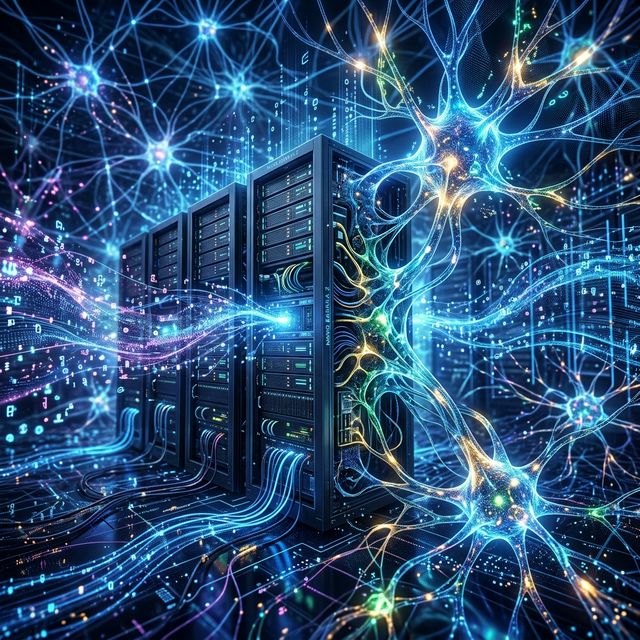
The New Developer Experience: Engineering for Mutation
How do WordPress developers build for a platform that constantly reshapes itself? The era of hard-coding exact pixel layouts in theme.json and static PHP templates is ending. Developers will no longer design layouts; they will design boundaries and intents.
Theme development will pivot toward creating flexible, atomic design systems. Developers will build modular Gutenberg blocks with vast arrays of configurable parameters. Instead of writing conditional PHP logic (e.g., if ( is_mobile() ) { ... }), developers will provide the localized AI with highly structured system prompts and boundary rules.
Prompt-Driven Structural Orchestration
In this new paradigm, the WordPress dashboard will include entirely new interfaces for “Mutation Parameters.” Site owners will define the overarching goals of the site—”Maximize conversions,” “Increase time on page,” “Ensure ADA compliance”—and the AI will autonomously experiment with the structural layout to achieve these goals.
Developers will use standards like the W3C WebAssembly Specification to write custom, high-performance edge modules in languages like Rust or Go, compiling them to WASM to be invoked seamlessly by the PHP core. PHP’s role transitions from a heavy rendering engine to a lightweight orchestration layer, passing user state to the AI, receiving the mutated block tree, and handing it to the WASM rendering pipeline.
Redefining State: Edge Databases and Distributed Consensus
A critical question arises: If compute and structural AI operate at the extreme edge, what happens to the database? WordPress is heavily reliant on relational data. A decentralized web cannot survive on a centralized MySQL database without introducing latency that defeats the purpose of the edge.
The solution lies in distributed state management. Native SQLite compiled to WASM allows the edge node to maintain a local, ultra-fast read replica of the site’s database. Every time a localized AI makes a structural mutation or a user submits data, the transaction is recorded instantly on the edge node’s local SQLite instance.
In the background, asynchronous background workers utilize CRDTs (Conflict-free Replicated Data Types) to synchronize these delta changes back to a globally distributed database cluster. This ensures eventual consistency across the globe without ever blocking the user’s initial request. The user experiences zero latency, while the global WordPress network maintains total data integrity.
The Semantic Web Realized
For decades, technologists have dreamed of the Semantic Web—an internet that understands the meaning and context of the data it serves. By marrying WASM edge execution with localized AI structural mutation, WordPress is uniquely positioned to manifest this dream on a massive scale.
Because WordPress already structures its data semantically via the Gutenberg Block API, it provides the perfect mathematical canvas for AI to manipulate. The AI does not have to parse messy, unstructured HTML. It interacts with clean, declarative JSON objects representing headers, paragraphs, lists, and interactive components. It understands that a wp:quote block carries different semantic weight than a wp:image block, allowing it to reassemble layouts in ways that prioritize cognitive accessibility and user comprehension.
Conclusion: The Inevitable Horizon
The transition from centralized monoliths to distributed, intelligent edge nodes is not a mere trend; it is the inevitable trajectory of computer science. The physics of latency and the economics of global scale demand it. WordPress, carrying the monumental weight of 40% of the web, has a responsibility to lead this charge.
By executing PHP securely inside WASM edge loops, we eliminate the origin server bottleneck and eradicate entire classes of traditional vulnerabilities. By introducing localized AI models directly into these loops, we empower the CMS to inject real-time structural changes, delivering a bespoke, hyper-personalized web experience to every single human being on the planet.
We are no longer building websites. We are engineering sentient digital ecosystems. The tools are here. The specifications are written. The monolith is crumbling. It is time to embrace the edge, empower the AI, and build the future of WordPress.
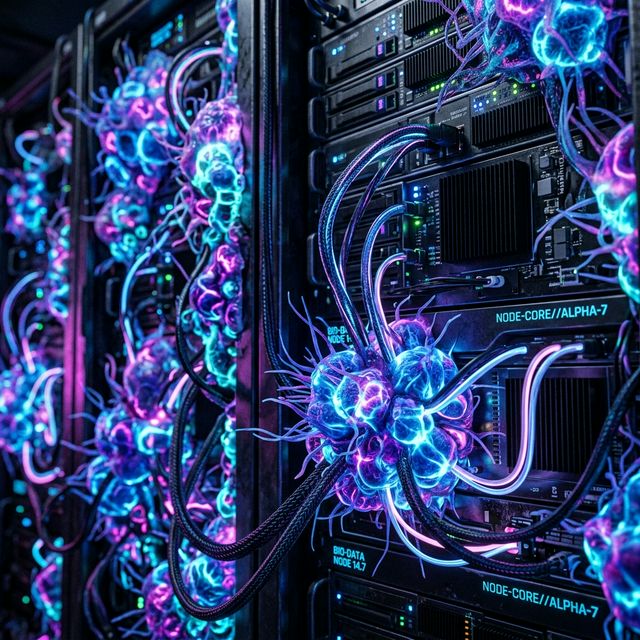
The Mechanics of the Edge Loop
An edge loop is a highly optimized, event-driven execution environment running on distributed Points of Presence (PoPs). Unlike traditional PHP-FPM, which requires heavy process forks and persistent memory overhead, a WASM edge loop can instantiate a complete WordPress environment in less than 5 milliseconds. It processes the request, generates the response, and instantly terminates.
Because the execution environment is ephemeral, state is separated from compute. The traditional MySQL database is replaced by distributed edge databases utilizing SQLite over WASM, synchronized globally via Conflict-free Replicated Data Types (CRDTs). This means that every single visitor, no matter where they are on Earth, interacts with a localized, dedicated instance of WordPress that boots and dies in the blink of an eye.
Cryptographic Security and the Death of Traditional Malware
By executing PHP securely inside WASM edge loops, we completely rewrite the security paradigm of WordPress. The WASM sandbox is a deny-by-default environment. Even if a zero-day vulnerability exists in a poorly coded WordPress plugin, the attacker cannot break out of the WASM module. There is no underlying host shell to invoke. There are no traditional file permissions to exploit.
Furthermore, because the WASM instance is ephemeral, persistence is impossible. A malicious actor could attempt to inject a backdoor, but the entire execution environment is annihilated the moment the HTTP response is sent. The next request spins up a pristine, cryptographically verified WASM binary. Malware cannot survive in an environment that literally ceases to exist every few milliseconds.
The Missing Link: Localized AI Models at the Edge
Decentralizing compute and securing PHP via WASM solves the infrastructure problem, but it is only the first half of the revolution. The second half is cognitive. Once WordPress is running at the edge, it gains the ability to process localized context with zero latency. This is where Artificial Intelligence enters the architecture—not as a slow, costly API call to a centralized provider like OpenAI, but as localized, quantized models running adjacent to the WASM edge loop.
Advances in model quantization—such as the GGUF format—have allowed incredibly capable Small Language Models (SLMs) to run efficiently on CPU architectures with minimal RAM. According to recent research on efficient localized edge inference, we can now run highly specialized 3-billion to 8-billion parameter models directly on edge nodes without requiring massive server-side GPU clusters.
These models serve as the localized “brain” of the WordPress instance. Because they run on the same edge node as the WASM PHP execution, the latency between the CMS and the AI is practically zero. The AI does not just generate text; it acts as a sentient orchestrator capable of analyzing the context of the incoming request—geolocation, time of day, device capabilities, user intent, and historical behavior—and making profound structural decisions.
Real-Time Structural Mutation: The Sentient CMS
Historically, AI in content management has been relegated to the backend: generating blog posts, summarizing articles, or translating text. The end-user still receives a static layout. In the WASM-AI paradigm, the localized AI model is granted agency over the Document Object Model (DOM) and the Gutenberg block architecture itself. We call this Real-Time Structural Mutation.
WordPress natively structures content as a tree of Gutenberg blocks, represented under the hood as JSON-like data attributes. When a request hits the edge node, the localized AI analyzes the user’s context. Rather than simply serving a pre-defined template, the AI dynamically injects, modifies, or completely re-architects the Gutenberg block structure in real-time, right before the WASM loop renders the HTML.
Contextual Layout Generation
Imagine a global e-commerce brand powered by this new WordPress architecture. Two different users visit the same URL.
User A is a first-time visitor from a mobile device in Tokyo during a morning commute. The edge AI detects this context. It instantly mutates the homepage block structure. It strips out heavy, multi-column video blocks (wp:video). It promotes a clean, high-contrast typography block (wp:heading) and dynamically generates a lightweight, highly-targeted “Quick Purchase” block grid (wp:columns) optimized for one-handed mobile use.
User B is a returning desktop visitor from New York, arriving on a Sunday evening via an organic search for “deep dive technical specs.” The localized AI detects the intent. It mutates the Gutenberg structure entirely differently. It injects rich, interactive data visualization blocks, expands technical accordion blocks (wp:details), and dynamically constructs a personalized sidebar featuring related long-form content based on their previous browsing history.
In both scenarios, there is no loading spinner. There is no client-side JavaScript layout shift (CLS). Because the localized AI model and the WASM PHP loop operate synchronously at the edge node, the mutated Gutenberg block structure is rendered into raw, lightning-fast HTML and delivered to the browser instantly.
The website is no longer a static building that visitors walk through. It is a liquid environment that reshapes its own architecture around the specific contours of the person looking at it.
The Death of Static Caching
This architectural shift fundamentally obliterates the concept of traditional caching. When structural mutation becomes the standard, no two page loads are identical. If an AI is constantly tailoring the Gutenberg block tree for every individual request, serving a static, pre-rendered HTML file from a CDN is counterproductive.
Critics will argue that dynamic generation for every request is unscalable. But that assumes traditional origin-server economics. When compute is shifted to WASM edge loops, and localized models are highly quantized, the cost of dynamic generation plummets. We replace the concept of “HTML Caching” with “Component Edge Caching” and “Semantic Prediction.”
The AI does not generate the entire site from scratch on every load; rather, it intelligently retrieves pre-compiled WASM block components and stitches them together. It caches the logic and the vectors, not the final HTML string. This ensures that the dynamic assembly is executed within millisecond thresholds, satisfying both Google’s Core Web Vitals and the demand for absolute personalization.
The New Developer Experience: Engineering for Mutation
How do WordPress developers build for a platform that constantly reshapes itself? The era of hard-coding exact pixel layouts in theme.json and static PHP templates is ending. Developers will no longer design layouts; they will design boundaries and intents.
Theme development will pivot toward creating flexible, atomic design systems. Developers will build modular Gutenberg blocks with vast arrays of configurable parameters. Instead of writing conditional PHP logic (e.g., if ( is_mobile() ) { ... }), developers will provide the localized AI with highly structured system prompts and boundary rules.
Prompt-Driven Structural Orchestration
In this new paradigm, the WordPress dashboard will include entirely new interfaces for “Mutation Parameters.” Site owners will define the overarching goals of the site—”Maximize conversions,” “Increase time on page,” “Ensure ADA compliance”—and the AI will autonomously experiment with the structural layout to achieve these goals.
Developers will use standards like the W3C WebAssembly Specification to write custom, high-performance edge modules in languages like Rust or Go, compiling them to WASM to be invoked seamlessly by the PHP core. PHP’s role transitions from a heavy rendering engine to a lightweight orchestration layer, passing user state to the AI, receiving the mutated block tree, and handing it to the WASM rendering pipeline.
Redefining State: Edge Databases and Distributed Consensus
A critical question arises: If compute and structural AI operate at the extreme edge, what happens to the database? WordPress is heavily reliant on relational data. A decentralized web cannot survive on a centralized MySQL database without introducing latency that defeats the purpose of the edge.
The solution lies in distributed state management. Native SQLite compiled to WASM allows the edge node to maintain a local, ultra-fast read replica of the site’s database. Every time a localized AI makes a structural mutation or a user submits data, the transaction is recorded instantly on the edge node’s local SQLite instance.
In the background, asynchronous background workers utilize CRDTs (Conflict-free Replicated Data Types) to synchronize these delta changes back to a globally distributed database cluster. This ensures eventual consistency across the globe without ever blocking the user’s initial request. The user experiences zero latency, while the global WordPress network maintains total data integrity.
The Semantic Web Realized
For decades, technologists have dreamed of the Semantic Web—an internet that understands the meaning and context of the data it serves. By marrying WASM edge execution with localized AI structural mutation, WordPress is uniquely positioned to manifest this dream on a massive scale.
Because WordPress already structures its data semantically via the Gutenberg Block API, it provides the perfect mathematical canvas for AI to manipulate. The AI does not have to parse messy, unstructured HTML. It interacts with clean, declarative JSON objects representing headers, paragraphs, lists, and interactive components. It understands that a wp:quote block carries different semantic weight than a wp:image block, allowing it to reassemble layouts in ways that prioritize cognitive accessibility and user comprehension.
Conclusion: The Inevitable Horizon
The transition from centralized monoliths to distributed, intelligent edge nodes is not a mere trend; it is the inevitable trajectory of computer science. The physics of latency and the economics of global scale demand it. WordPress, carrying the monumental weight of 40% of the web, has a responsibility to lead this charge.
By executing PHP securely inside WASM edge loops, we eliminate the origin server bottleneck and eradicate entire classes of traditional vulnerabilities. By introducing localized AI models directly into these loops, we empower the CMS to inject real-time structural changes, delivering a bespoke, hyper-personalized web experience to every single human being on the planet.
We are no longer building websites. We are engineering sentient digital ecosystems. The tools are here. The specifications are written. The monolith is crumbling. It is time to embrace the edge, empower the AI, and build the future of WordPress.
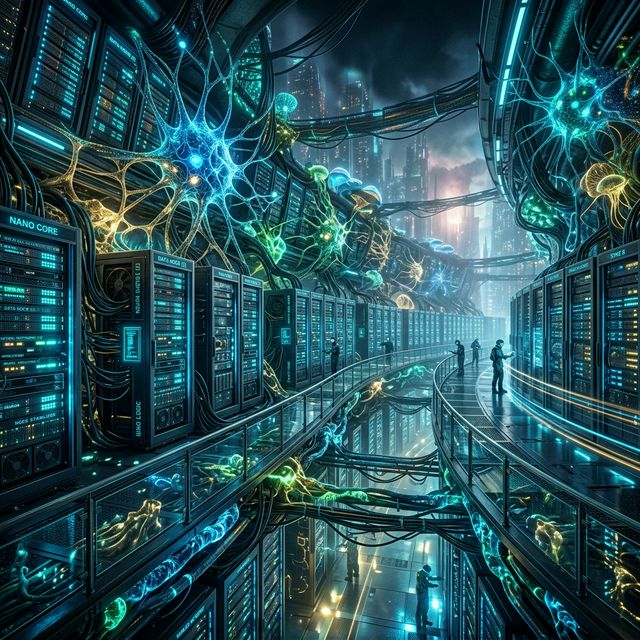
The Sentient Edge: A Manifesto for the Future of WordPress, WASM, and AI-Driven Structural Mutation
For more than two decades, the architecture of the web has been chained to a centralized paradigm. The origin server—a monolithic fortress of compute—has dictated the speed, security, and dynamism of the internet. WordPress, the undisputed titan that powers nearly half of the global web, has historically been bound by this architecture. It is a system built on the LAMP stack, reliant on synchronous database queries, PHP-FPM workers, and the fragile art of caching to survive traffic spikes. But this era is drawing to a definitive, overdue close.
We stand at the precipice of a foundational evolution. The future of WordPress is not an origin server. It is not a traditional cluster of load balancers. The future of WordPress is an infinitely distributed, sentient mesh network. By executing PHP securely inside WebAssembly (WASM) edge loops, and deploying localized Artificial Intelligence (AI) models to inject real-time structural changes into the Document Object Model (DOM), WordPress will transform from a static Content Management System into a dynamic, self-assembling digital organism.
This manifesto outlines the technical and philosophical blueprint for this revolution. It is a roadmap for tearing down the monolith and rebuilding the web at the edge, where speed is absolute, security is mathematically guaranteed, and user experiences are tailored at the atomic level in real-time.
The Monolith is Crumbling: The Limits of Traditional Architecture
To understand the necessity of this evolution, we must first confront the architectural debt of the modern web. Traditional WordPress requests follow a rigid, linear path. A user requests a page. The request travels across oceans and continents to reach an origin server. A reverse proxy (like Nginx) routes the request to PHP. PHP boots up, loads the WordPress core, queries a centralized MySQL database, retrieves the content, parses the template hierarchy, renders the HTML, and sends it all the way back to the user.
We have masked the profound inefficiency of this process with layers of caching—Varnish, Redis, Memcached, and Content Delivery Networks (CDNs). But caching is a band-aid. It is an admission of failure. Caching explicitly demands that we sacrifice dynamism for speed. We serve static HTML representations of the past because generating the present is simply too expensive.
Caching is an architectural compromise. It is the web’s way of apologizing for the latency of the origin server. When compute moves to the edge, the apology is no longer required.
Furthermore, the centralized origin server is a catastrophic single point of failure and a prime target for malicious actors. Traditional Remote Code Execution (RCE) vulnerabilities in PHP rely on exploiting the host operating system’s file system and memory space. As long as PHP runs on a traditional server with access to the underlying OS, the attack surface remains fundamentally unpluggable.
WebAssembly: Breaking PHP Out of the Server
The solution begins with WebAssembly (WASM). Originally designed to run high-performance code inside web browsers, WASM has escaped the browser and become a universal compilation target. Through the WebAssembly System Interface (WASI), we can now run compiled languages natively on any operating system, securely sandboxed, with near-native performance.
Projects like WordPress Playground have already proven that the entire WordPress stack—PHP, a SQLite database, and an Apache-like request layer—can be compiled into WASM and run directly in a browser. But the true paradigm shift occurs when we deploy this WASM-compiled WordPress to the edge compute layer (e.g., Cloudflare Workers, Vercel Edge, Deno Deploy).
Instead of a user’s request traveling to an origin server, the request hits an edge node located mere miles from their physical location. At this edge node, a WASM runtime spins up a completely isolated, ephemeral instance of WordPress. PHP is executed inside a WASM edge loop.
The Mechanics of the Edge Loop
An edge loop is a highly optimized, event-driven execution environment running on distributed Points of Presence (PoPs). Unlike traditional PHP-FPM, which requires heavy process forks and persistent memory overhead, a WASM edge loop can instantiate a complete WordPress environment in less than 5 milliseconds. It processes the request, generates the response, and instantly terminates.
Because the execution environment is ephemeral, state is separated from compute. The traditional MySQL database is replaced by distributed edge databases utilizing SQLite over WASM, synchronized globally via Conflict-free Replicated Data Types (CRDTs). This means that every single visitor, no matter where they are on Earth, interacts with a localized, dedicated instance of WordPress that boots and dies in the blink of an eye.
Cryptographic Security and the Death of Traditional Malware
By executing PHP securely inside WASM edge loops, we completely rewrite the security paradigm of WordPress. The WASM sandbox is a deny-by-default environment. Even if a zero-day vulnerability exists in a poorly coded WordPress plugin, the attacker cannot break out of the WASM module. There is no underlying host shell to invoke. There are no traditional file permissions to exploit.
Furthermore, because the WASM instance is ephemeral, persistence is impossible. A malicious actor could attempt to inject a backdoor, but the entire execution environment is annihilated the moment the HTTP response is sent. The next request spins up a pristine, cryptographically verified WASM binary. Malware cannot survive in an environment that literally ceases to exist every few milliseconds.
The Missing Link: Localized AI Models at the Edge
Decentralizing compute and securing PHP via WASM solves the infrastructure problem, but it is only the first half of the revolution. The second half is cognitive. Once WordPress is running at the edge, it gains the ability to process localized context with zero latency. This is where Artificial Intelligence enters the architecture—not as a slow, costly API call to a centralized provider like OpenAI, but as localized, quantized models running adjacent to the WASM edge loop.
Advances in model quantization—such as the GGUF format—have allowed incredibly capable Small Language Models (SLMs) to run efficiently on CPU architectures with minimal RAM. According to recent research on efficient localized edge inference, we can now run highly specialized 3-billion to 8-billion parameter models directly on edge nodes without requiring massive server-side GPU clusters.
These models serve as the localized “brain” of the WordPress instance. Because they run on the same edge node as the WASM PHP execution, the latency between the CMS and the AI is practically zero. The AI does not just generate text; it acts as a sentient orchestrator capable of analyzing the context of the incoming request—geolocation, time of day, device capabilities, user intent, and historical behavior—and making profound structural decisions.
Real-Time Structural Mutation: The Sentient CMS
Historically, AI in content management has been relegated to the backend: generating blog posts, summarizing articles, or translating text. The end-user still receives a static layout. In the WASM-AI paradigm, the localized AI model is granted agency over the Document Object Model (DOM) and the Gutenberg block architecture itself. We call this Real-Time Structural Mutation.
WordPress natively structures content as a tree of Gutenberg blocks, represented under the hood as JSON-like data attributes. When a request hits the edge node, the localized AI analyzes the user’s context. Rather than simply serving a pre-defined template, the AI dynamically injects, modifies, or completely re-architects the Gutenberg block structure in real-time, right before the WASM loop renders the HTML.
Contextual Layout Generation
Imagine a global e-commerce brand powered by this new WordPress architecture. Two different users visit the same URL.
User A is a first-time visitor from a mobile device in Tokyo during a morning commute. The edge AI detects this context. It instantly mutates the homepage block structure. It strips out heavy, multi-column video blocks (wp:video). It promotes a clean, high-contrast typography block (wp:heading) and dynamically generates a lightweight, highly-targeted “Quick Purchase” block grid (wp:columns) optimized for one-handed mobile use.
User B is a returning desktop visitor from New York, arriving on a Sunday evening via an organic search for “deep dive technical specs.” The localized AI detects the intent. It mutates the Gutenberg structure entirely differently. It injects rich, interactive data visualization blocks, expands technical accordion blocks (wp:details), and dynamically constructs a personalized sidebar featuring related long-form content based on their previous browsing history.
In both scenarios, there is no loading spinner. There is no client-side JavaScript layout shift (CLS). Because the localized AI model and the WASM PHP loop operate synchronously at the edge node, the mutated Gutenberg block structure is rendered into raw, lightning-fast HTML and delivered to the browser instantly.
The website is no longer a static building that visitors walk through. It is a liquid environment that reshapes its own architecture around the specific contours of the person looking at it.
The Death of Static Caching
This architectural shift fundamentally obliterates the concept of traditional caching. When structural mutation becomes the standard, no two page loads are identical. If an AI is constantly tailoring the Gutenberg block tree for every individual request, serving a static, pre-rendered HTML file from a CDN is counterproductive.
Critics will argue that dynamic generation for every request is unscalable. But that assumes traditional origin-server economics. When compute is shifted to WASM edge loops, and localized models are highly quantized, the cost of dynamic generation plummets. We replace the concept of “HTML Caching” with “Component Edge Caching” and “Semantic Prediction.”
The AI does not generate the entire site from scratch on every load; rather, it intelligently retrieves pre-compiled WASM block components and stitches them together. It caches the logic and the vectors, not the final HTML string. This ensures that the dynamic assembly is executed within millisecond thresholds, satisfying both Google’s Core Web Vitals and the demand for absolute personalization.
The New Developer Experience: Engineering for Mutation
How do WordPress developers build for a platform that constantly reshapes itself? The era of hard-coding exact pixel layouts in theme.json and static PHP templates is ending. Developers will no longer design layouts; they will design boundaries and intents.
Theme development will pivot toward creating flexible, atomic design systems. Developers will build modular Gutenberg blocks with vast arrays of configurable parameters. Instead of writing conditional PHP logic (e.g., if ( is_mobile() ) { ... }), developers will provide the localized AI with highly structured system prompts and boundary rules.
Prompt-Driven Structural Orchestration
In this new paradigm, the WordPress dashboard will include entirely new interfaces for “Mutation Parameters.” Site owners will define the overarching goals of the site—”Maximize conversions,” “Increase time on page,” “Ensure ADA compliance”—and the AI will autonomously experiment with the structural layout to achieve these goals.
Developers will use standards like the W3C WebAssembly Specification to write custom, high-performance edge modules in languages like Rust or Go, compiling them to WASM to be invoked seamlessly by the PHP core. PHP’s role transitions from a heavy rendering engine to a lightweight orchestration layer, passing user state to the AI, receiving the mutated block tree, and handing it to the WASM rendering pipeline.
Redefining State: Edge Databases and Distributed Consensus
A critical question arises: If compute and structural AI operate at the extreme edge, what happens to the database? WordPress is heavily reliant on relational data. A decentralized web cannot survive on a centralized MySQL database without introducing latency that defeats the purpose of the edge.
The solution lies in distributed state management. Native SQLite compiled to WASM allows the edge node to maintain a local, ultra-fast read replica of the site’s database. Every time a localized AI makes a structural mutation or a user submits data, the transaction is recorded instantly on the edge node’s local SQLite instance.
In the background, asynchronous background workers utilize CRDTs (Conflict-free Replicated Data Types) to synchronize these delta changes back to a globally distributed database cluster. This ensures eventual consistency across the globe without ever blocking the user’s initial request. The user experiences zero latency, while the global WordPress network maintains total data integrity.
The Semantic Web Realized
For decades, technologists have dreamed of the Semantic Web—an internet that understands the meaning and context of the data it serves. By marrying WASM edge execution with localized AI structural mutation, WordPress is uniquely positioned to manifest this dream on a massive scale.
Because WordPress already structures its data semantically via the Gutenberg Block API, it provides the perfect mathematical canvas for AI to manipulate. The AI does not have to parse messy, unstructured HTML. It interacts with clean, declarative JSON objects representing headers, paragraphs, lists, and interactive components. It understands that a wp:quote block carries different semantic weight than a wp:image block, allowing it to reassemble layouts in ways that prioritize cognitive accessibility and user comprehension.
Conclusion: The Inevitable Horizon
The transition from centralized monoliths to distributed, intelligent edge nodes is not a mere trend; it is the inevitable trajectory of computer science. The physics of latency and the economics of global scale demand it. WordPress, carrying the monumental weight of 40% of the web, has a responsibility to lead this charge.
By executing PHP securely inside WASM edge loops, we eliminate the origin server bottleneck and eradicate entire classes of traditional vulnerabilities. By introducing localized AI models directly into these loops, we empower the CMS to inject real-time structural changes, delivering a bespoke, hyper-personalized web experience to every single human being on the planet.
We are no longer building websites. We are engineering sentient digital ecosystems. The tools are here. The specifications are written. The monolith is crumbling. It is time to embrace the edge, empower the AI, and build the future of WordPress.
// SYSTEM AUDIT INTAKE
Ensure your infrastructure is quantum-resilient and operating at peak efficiency. Request a complimentary architectural consultation regarding topics discussed in this log.