Investor Prospectus
THE THESIS: THE END OF CONTAINER BLOAT
Legacy cloud infrastructure (Docker, Kubernetes, Linux namespaces) is drowning in virtualization overhead, thermal inefficiency, and synchronous bottlenecks. It was not built for the AI era.
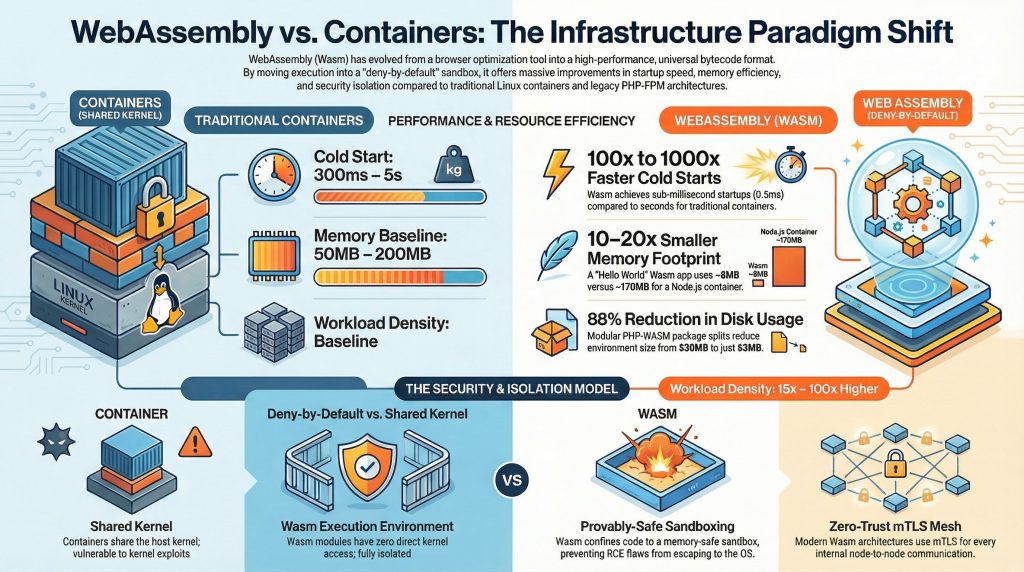
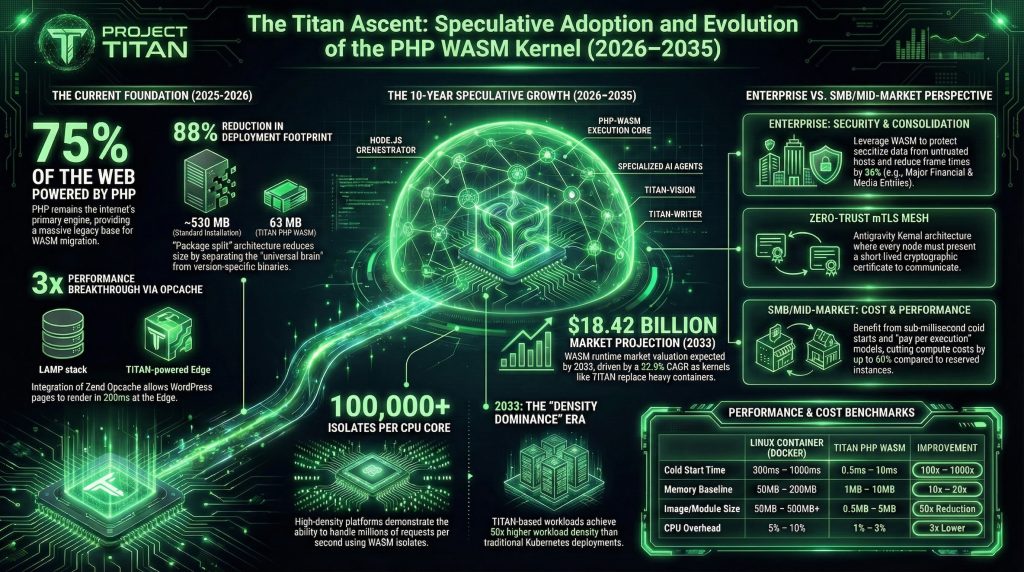
DESIGNA has engineered a sovereign, WebAssembly-native compute fabric. By bypassing traditional OS-level virtualization, our proprietary “Antigravity Kernel” achieves sub-millisecond cold starts (0.5ms vs 5s legacy) and <2ms edge execution latency. We have decoupled the web request cycle from heavy LLM inference, creating a hyper-scalable, asynchronous micro-grid that delivers massive compute power at a fraction of the thermal and financial cost. By upgrading PHP—the language powering 75% of the internet—to a Wasm-native standard, we are not asking the market to learn a new stack; we are weaponizing their existing foundation.
THE ARCHITECTURAL MOATS
We do not rent infrastructure; we invented a new physics for the cloud.
- The Polyglot WebAssembly (Wasm) Micro-Grid: We orchestrated a heterogeneous matrix executing code natively at the absolute edge. Wasm’s “deny-by-default,” capability-based memory model eliminates entire classes of OS-level vulnerabilities. We represent the next generation of PHP, operating with an 88% reduction in deployment footprint and a 10-20x smaller memory baseline than traditional containers.
- Density Dominance: Legacy nodes crash under concurrent load. Our Wasm architecture scales to 100,000+ isolates per CPU core, achieving 50x higher workload density than standard Kubernetes deployments.
- The 11-Node Autonomous AI Supercluster: We deeply integrated state-of-the-art foundation models via an asynchronous Model Context Protocol (MCP) mesh. Gemini 3.1 Pro acts as the Supreme Commander, while localized Gemini 3.1 Flash-light instances operate as the Immune System (sub-1000ms latency pre-commit hooks and zero-bias auditing).
- eBPF Telemetry & DESIGNA Zero-Trust: All internal communication flows through strict mutual TLS (mTLS) sidecar tunnels. Pre-flight eBPF telemetry parses network requests and drops hostile payloads before user context is built, piping lossless system metrics directly into our ledgers.
COMMERCIAL VECTORS & MONETIZATION
DESIGNA is actively monetizing this architecture across three high-margin verticals within a Wasm runtime market projected to reach $18.42 Billion by 2033 (22.9% CAGR):
- Enterprise Tenant Provisioning (Sovereign Infrastructure): Transitioning to a public enrollment model where developers and enterprises rent isolated, cryptographically secure Wasm sandboxes. We provide the stable, ultimate utility armory for the next decade of web computing.
- AdTech Edge Compute (The Titan VAST Engine): Bypassing legacy ad-server latency to deliver logic-heavy, edge-native video wrappers. We designed our telemetry to support millions of concurrent hits and event requests securely, reducing enterprise frame times by up to 36%.
- Next-Generation Gaming (The DNS Engine): “Definitely Not SCUMM” is our proprietary Wasm-native game engine. It utilizes asynchronous graph-based narrative state machines and JIT generative asset synthesis to revolutionize interactive media without client-side binary bloat.
THE FINANCIAL ARBITRAGE: $1.5B+ VALUATION TARGET
Our valuation model is driven by Thermal Efficiency Arbitrage and Unit Economics. Because our Wasm micro-grid eliminates the compute waste inherent in legacy cloud topologies, we can run high-density AI and edge workloads at a radically compressed cost basis.
- For the Client: Zero-latency execution, military-grade data sovereignty, and up to a 60% reduction in compute costs compared to reserved cloud instances.
- For DESIGNA: Exponential margin expansion. The unit economics are irrefutable: every CPU cycle and gigabyte of RAM saved by bypassing Linux userspace bloat falls directly to the bottom line, allowing us to scale profitably from day one.
LEADERSHIP
Founded by Andrew Rulnick (Chief Architect), a deep-tech pioneer with a proven track record of managing $100M+ mixed-media P&Ls, pioneering AI integrations for Fortune 500s, and achieving 100X performance optimizations in vector data pipelines.